


Chargeback Management: Protect Your Merchant Account
A chargeback is not always fraud. Increasingly, it is a dispute initiated by the customer after a legitimate purchase: the buyer received the product but still challenged the payment as unauthorized. The industry calls this Friendly Fraud, and according to Visa-based estimates, these “friendly” disputes account for roughly three quarters of all disputes.
For a large merchant, this creates a double impact: genuinely fraudulent transactions must be blocked before authorization, while disputes from legitimate customers must be resolved before they turn into formal chargebacks. Both processes are now governed by payment-network rules that have become noticeably stricter in 2026.
The New Rules: VAMP and Mastercard Programs
Effective April 1, 2026, Visa reduced the “excessive” threshold under the Visa Acquirer Monitoring Program (VAMP) from 2.2% to 1.5% for merchants in the United States, Canada, the European Union, and APAC. The metric is calculated as the total number of fraud reports (TC40) and disputes (TC15), divided by the number of clearing transactions. This means the same dispute can technically be counted twice: first as a fraud signal and then as a chargeback. Visa also introduced a separate threshold for enumeration attacks, or automated card-testing activity, set at 20%. When the limit is exceeded, the merchant pays $8 for every transaction above the threshold.
Mastercard applies a similar but separate framework. Entry into the Excessive Chargeback Merchant Program begins at 100 or more chargebacks per month with a chargeback ratio of at least 1.5%. The more severe High Excessive Chargeback Merchant level begins at 300 chargebacks and a ratio of at least 3%.
The practical conclusion is straightforward: merchants can no longer monitor the chargeback ratio alone. They must track the combined metric across both card networks and intervene before a complaint becomes a formal dispute—not after.
Why Blocking Everything Is a Poor Strategy
The first reaction to an increase in disputes is often to tighten anti-fraud filters and require identity verification for nearly every transaction. This may reduce fraud, but it can severely damage conversion. Legitimate, solvent customers begin receiving declines or additional authentication steps in situations where no meaningful risk existed in the first place.
A workable balance is built differently:
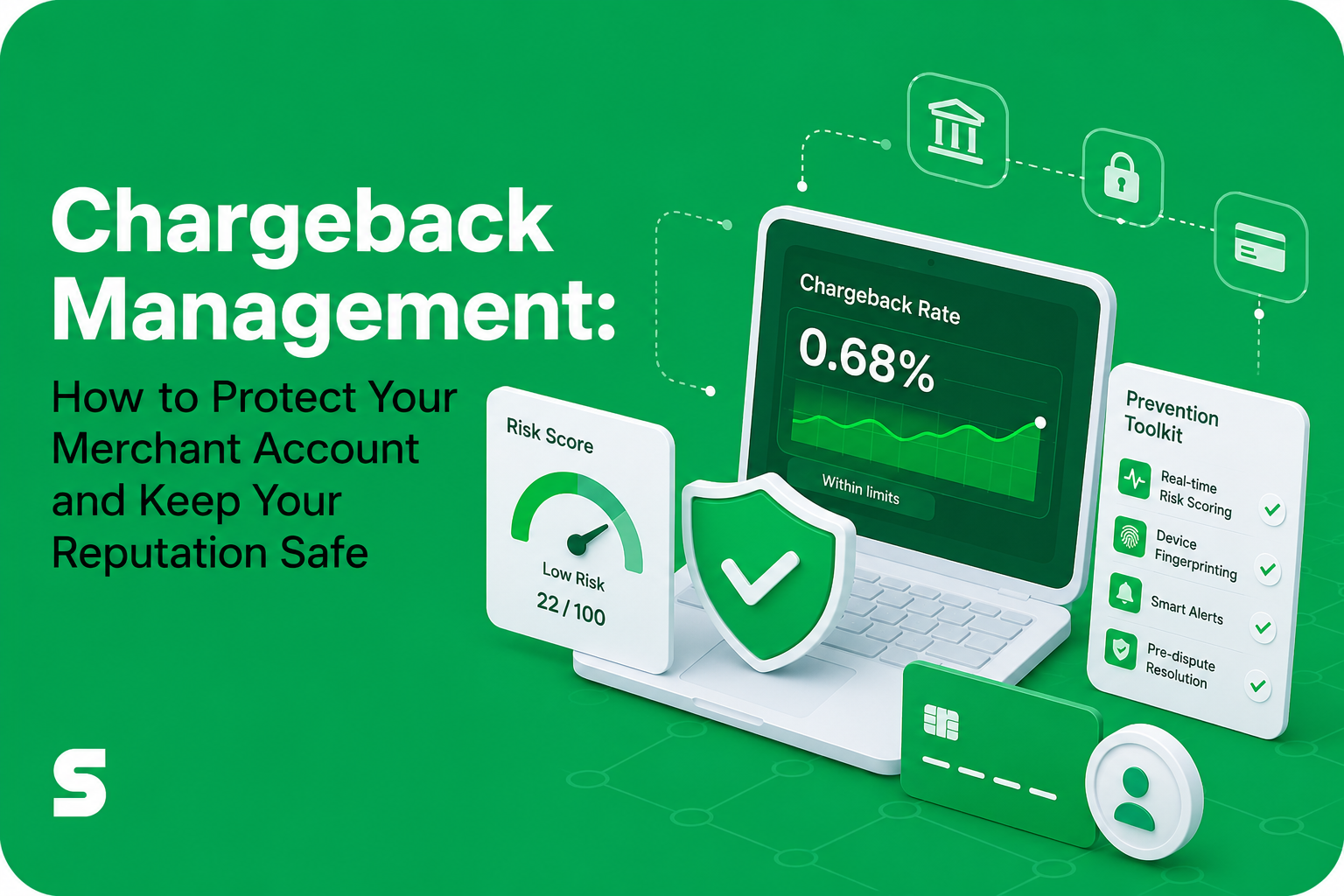
- real-time risk scoring, where an additional check such as 3-D Secure is triggered only for higher-risk transactions rather than for every payment;
- behavioral analysis and device fingerprinting, which distinguish a legitimate returning customer from an anomalous pattern;
- predictive alert mechanisms, which give the merchant an opportunity to issue a refund before a complaint escalates into an official chargeback;
- clear billing descriptors and proactive notifications, which reduce a significant share of Friendly Fraud caused simply because the customer did not recognize the charge on their statement.
A Strategy for Keeping the Chargeback Rate Below Critical Thresholds
| Protection layer | What it does | Effect |
|---|---|---|
| Preventive | Risk scoring, adaptive 3DS, and device verification | Fewer fraudulent transactions reach the authorization stage |
| Pre-dispute | Alert systems and rapid refunds before escalation into TC15 | The complaint never enters chargeback statistics |
| Post-dispute | Collecting evidence that the transaction was legitimate, including purchase history, IP data, and device information | More disputes won and less reputational damage |
Each protection layer reduces the burden on the next one. The fewer complaints that reach the formal chargeback stage, the fewer cases require manual representation—and the more consistently the merchant’s metrics remain below the excessive thresholds set by both Visa and Mastercard.
Conclusion
An increase in disputes is not a reason to choose between security and conversion. A properly designed, multilayered protection strategy reduces both genuine fraud and Friendly Fraud without cutting off legitimate traffic.
At Spoynt, we help merchants build exactly this kind of multilayered protection—from real-time risk scoring at the point of entry to pre-dispute resolution tools—so that the Chargeback Rate remains consistently below the critical thresholds established by international payment networks and the merchant account’s reputation is not damaged by isolated spikes in disputes.
Key takeaway: The winner is not the merchant that blocks the most transactions, but the one that can stop a dispute before it becomes a chargeback—without disrupting legitimate traffic.


Latest News
See all articles-
 Education
The Evolution of Checkout: How Biometrics and AI Personalization Are Changing Payments
16 June, 2026 -
 Case studies
Spoynt successfully passed PCI DSS certification
4 November, 2023 -
 Education
Chargeback Management: Protect Your Merchant Account
17 July, 2026